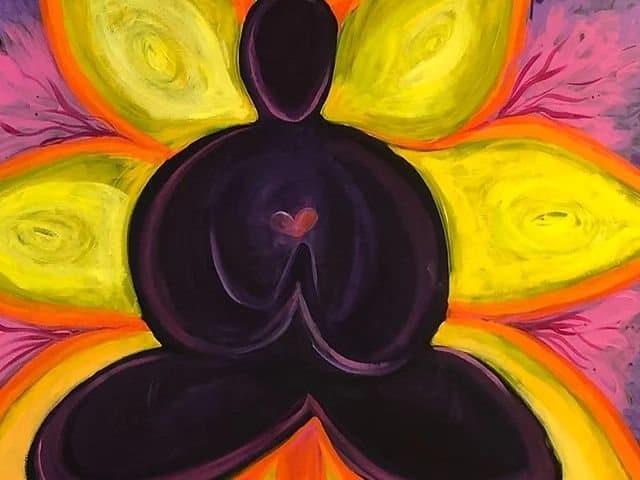

Group ketamine therapy, or group KAP, brings a small circle of adults together for a medically supervised ketamine session led by trained facilitators, followed by quiet reflection and optional sharing. It’s for people who are ready for ketamine work and suspect that healing alongside others, rather than alone, might be part of what they need.
Every person in the circle has their own medical evaluation and their own individualized dose. What’s shared is the space: the intention-setting at the start, the silence while the medicine works, and the chance afterward to hear that someone else felt what you felt.
SomaVerse’s group journeys meet in Lawrence, where our group space is. We offer the Into the SomaVerse weekend ketamine retreat, a $150 SomaVerse Booster Group for people who’ve completed a SomaVerse program, and $20 integration groups for making sense of what comes up. Group work is one part of our wider ketamine-assisted psychotherapy (KAP) program.
Group work may call to you if…
- Depression or anxiety has made your world small, and you’ve lost touch with how many people feel the same way.
- You’re a therapist, nurse, first responder or caregiver who spends all day holding others and is rarely held.
- Shame keeps telling you that you’re uniquely broken, and you’d like some evidence otherwise.
- Individual ketamine sessions have helped, and you’re curious what happens in community.
- You want the depth of a ketamine session at a lower cost than one-on-one therapy.
- Circles, rituals and shared practice, from yoga classes to recovery meetings, have always steadied you.
What is group ketamine therapy?
Group KAP is ketamine-assisted psychotherapy for several people at once: each person takes their own prescribed dose in the same room, at the same time, supported by trained facilitators and medical oversight.
It isn’t a party, and it isn’t a shortcut. A group follows the same arc as individual KAP, with preparation, a dosing session and integration, but part of the integration is communal. You witness others and are witnessed, which can loosen the isolation that so often travels with depression, trauma and grief.
Group formats have a place in research, too. In Canada, the Roots To Thrive program embeds group ketamine-assisted therapy in a 12-week “community of practice” and has published both outcomes and a detailed clinical protocol. We share its core idea: community is part of the medicine.
You’re never required to speak
Sharing is optional, always. Plenty of people stay quiet in their first group and still leave feeling connected.
After the dose, most of the session happens inward, with eye shades, music and silence. Nobody is asked to perform an experience or explain it. When the medicine softens and the circle reopens, you can offer a word, a story, or nothing at all.
Many people find that listening is where the healing happens. Hearing a stranger describe the same fear you carry, or the same unexpected tenderness, can do something that years of private insight couldn’t.
Group size, confidentiality and safety
Groups are deliberately small, every participant agrees to keep what’s shared in the room, and medical oversight covers everyone.
Our weekend retreat and Booster Group each run with 6 to 10 participants. Small numbers let facilitators track each person, notice who needs support, and keep the room calm. Published group KAP programs use similar sizes; one recent case series ran groups of six.
Before the first session, everyone commits to a confidentiality agreement: names, stories and anything said or done under the medicine stay in the group. Facilitators are bound by professional confidentiality, and participants make the same promise to one another. We’ll also be honest about the limits, because no group can fully guarantee what another member does.
Each participant has their own medical evaluation, prescription and readiness check, and trained staff stay present for the entire session. If someone needs individual attention, a facilitator can step in without disrupting the circle.
Why healing together can go deeper
Shame thrives in isolation, and a group interrupts isolation in a way individual therapy can’t.
Many people arrive convinced their pain is theirs alone. In a group, that belief meets evidence. Someone names the grief you’ve never said aloud. Someone describes the same strange peace. The nervous system registers that it’s among people, not alone, and something can settle.
There’s also the simple experience of being seen while vulnerable and finding you’re still accepted. For people whose wounds happened in relationship, that can be quietly corrective.
What does the research say about group KAP?
Early studies are encouraging, but they’re small and uncontrolled, so we treat them as promising rather than proven.
In Roots To Thrive’s first published cohorts, 94 healthcare providers with PTSD or depression completed 12 weeks of group ketamine-assisted therapy; afterward, most reported less anxiety and depression, and many who had screened positive for PTSD no longer did (Dames 2021). A 2025 case series of healthcare workers and first responders, with three ketamine sessions and four group therapy sessions in groups of six, found median improvements in depression, anxiety, PTSD and burnout scores, with adverse events rare (Flynn 2025).
These are observational studies of selected groups without control conditions, so no one can yet say whether group KAP works as well as individual KAP, or better. What they do suggest is that group formats can be delivered safely and that participants often value the community itself.
Who group work suits, and who should start one-on-one
Group KAP suits many adults who are medically cleared and ready to share space while vulnerable. Some people do better starting with individual sessions.
Starting individually often makes sense if you’ve never taken ketamine and feel anxious about how you’ll react, if you’re working with recent or intense trauma that needs focused attention, or if being around others while vulnerable feels unsafe right now. Individual in-office sessions let you learn the medicine first.
Many clients combine the two over time: a few individual sessions, then group work, with integration therapy throughout. We’ve also offered groups built around a shared experience, such as a men’s ketamine healing group, and clinicians can experience group dosing in our ketamine training and certification program.
The SomaVerse Booster Group: returning to the circle
The SomaVerse Booster Group is for people who have completed a SomaVerse program and want to revisit and deepen the work.
It’s a group journey for 6 to 10 people, held in Lawrence, with the same structure as our other groups: a readiness check, an individual dose, quiet time inward, and optional sharing as the circle reopens. Many people find that returning to the medicine in community helps them notice how far they’ve come and what’s still asking for attention. It’s $150 per person; text “SomaVerse” to (785) 615-1995 for upcoming dates.
What group ketamine therapy costs
Group formats share facilitator time, which brings the cost per person down. For comparison, a private 2-hour KAP session with a therapist is $350, self-pay.
Into the SomaVerse, our weekend ketamine retreat at 616 Kentucky St in Lawrence, is $999 per participant for a group of 6 to 10. It includes your ketamine prescription, 3 days of group journeying, integration group work, expressive arts, meals, preparation and 2 post-integration sessions. The medical evaluation is billed separately, with insurance filed where it applies. The SomaVerse Booster Group is $150 per person, and integration groups are $20 for 60 minutes. Payment plans are available for bundled programs. See all pricing.